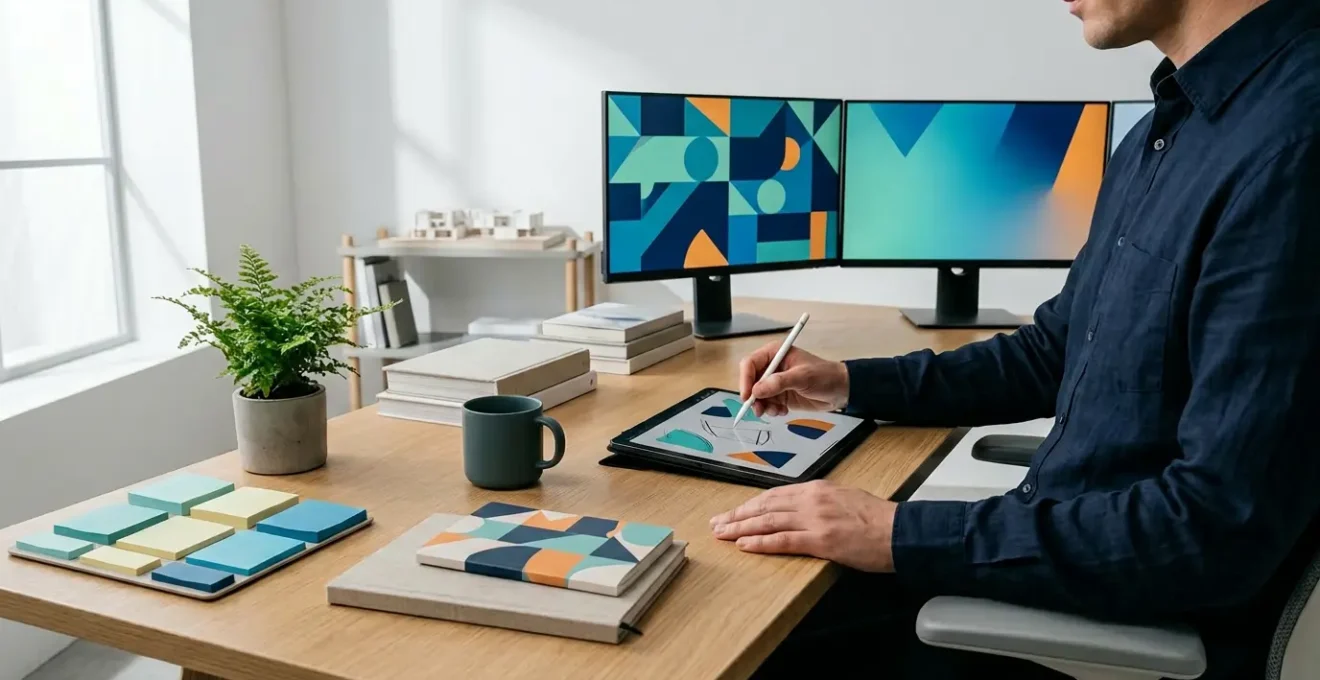
The key to a fundable pitch deck isn’t a massive design budget; it’s treating your visual assets as strategic, legally-defensible intellectual property from day one.
- Build a consistent brand kit using affordable tools like Canva, but inform your aesthetic with AI-generated mood boards specific to a UK/European context.
- Understand that UK copyright law requires explicit written assignment, making cheap freelance options a significant IP risk without the right contract.
- Use a component-based design approach to create master assets that can be repurposed for different platforms without losing quality or impact.
Recommendation: Before designing a single slide, conduct a UK trademark search and create a one-page brand guideline document to ensure every asset you create builds long-term value.
For an early-stage UK founder, hitting ‘send’ on a pitch deck email to a London VC can feel like dropping a message in a bottle into the Thames. You know the odds are stacked against you. The competition is fierce, and investor attention is a scarce, precious commodity. The common advice you hear is to « tell a good story » and « make it look professional, » which often leads founders down a rabbit hole of generic templates and a frantic search for a ‘quick, cheap’ designer.
But these surface-level tips miss the real point. In the sophisticated UK market, a pitch deck isn’t just a presentation; it’s the first tangible piece of intellectual property an investor interacts with. It’s a direct reflection of your resourcefulness, your attention to detail, and your strategic thinking. Simply grabbing a popular Canva template might make your deck look clean, but it also makes it look just like a dozen others an investor has seen that day. It lacks what we’ll call aesthetic sovereignty—a unique visual identity that you own and control.
This guide takes a different approach. We’re moving beyond the platitude of « good design matters. » Instead, we’ll focus on how to build your pitch deck and brand assets as a defensible strategic asset, not just a cosmetic layer. We will explore how to use accessible tools to create a professional look while building a solid legal scaffolding around your intellectual property. You’ll learn how to make informed choices that save you money now without costing you a fortune in legal fees or rebranding efforts later. This is about being scrappy, smart, and strategic—the exact traits VCs are looking for.
This article provides a comprehensive roadmap for creating high-impact visual assets on a startup budget. The following sections will guide you through the critical elements, from understanding investor psychology to the practical steps of protecting your work.
Contents: A Founder’s Guide to DIY Pitch Deck Assets
- Why a Poorly Designed Deck Will Get Your Email Deleted by London VCs?
- How to Assemble a Consistent Brand Kit Using Canva and AI Tools?
- Fiverr Designer or DIY: Which Is Safer for Your Core Logo Design?
- The Stock Photo Error That Could Result in a £1,000 Copyright Fine
- How to Resize and Repurpose One Asset for LinkedIn, Instagram, and Email?
- When to Raise Series B: The 3 Metrics UK VCs Look For Now
- How to File a UK Trademark Without Spending Thousands on Solicitors?
- How to Protect Intellectual Property in a Remote-First UK Workforce?
Why a Poorly Designed Deck Will Get Your Email Deleted by London VCs?
In the world of venture capital, first impressions are brutal and instantaneous. A London VC might receive hundreds of pitch decks a week, and they’ve developed heuristics to filter them in seconds. Poor design is one of the biggest red flags. It doesn’t just signal a lack of aesthetic taste; it implies a lack of attention to detail, a potential inability to execute, and a misunderstanding of the market. In a hyper-competitive environment, a visually weak presentation suggests the founder may not have what it takes to build a world-class company.
This isn’t just about using ugly fonts or clashing colours. It’s about demonstrating an understanding of the subtle visual language that communicates professionalism and ambition. Investors are pattern-matchers, and they associate certain aesthetics with success. You need to decide if your brand projects the innovative, disruptive energy of a Shoreditch tech hub or the established, dependable gravitas of Canary Wharf. Defaulting to generic, American-centric templates fails to make this conscious choice and can immediately signal that you’re an outsider.
As the image above illustrates, the aesthetic you choose is a strategic decision. A poorly designed deck is one that hasn’t made this decision consciously. It’s a missed opportunity to align your visual identity with the type of investor you want to attract and the market you aim to conquer. When an investor sees a deck that feels careless, it’s an easy signal to move on to the next one in their inbox. It’s not personal; it’s a time-saving mechanism in a high-volume industry.
How to Assemble a Consistent Brand Kit Using Canva and AI Tools?
Creating a professional brand presence no longer requires an in-house design team or a hefty agency retainer. For a resourceful founder, the combination of accessible tools like Canva and generative AI can produce a robust and consistent brand kit. The goal is to establish your company’s visual DNA—a core set of colours, fonts, and logo variations that ensures every asset, from a pitch deck slide to a social media post, feels cohesive and intentional.
The process starts not with design, but with strategy. Use AI tools like ChatGPT to brainstorm your brand’s personality. Is it innovative, trustworthy, playful, or sophisticated? Generate descriptions and a tone of voice guide. Then, take these concepts to a visual AI like Midjourney. Use prompts that specify a « modern UK startup aesthetic » or « European minimalist design » to generate mood boards. This crucial step helps you achieve aesthetic sovereignty by avoiding the default American-style visuals that flood many platforms and ensuring your brand feels culturally relevant to UK investors.
Once you have a clear visual direction, it’s time to build your kit in Canva. This is more than just picking a template; it’s about customisation. Use Canva’s Brand Kit feature to formally establish your chosen elements: upload your primary and secondary logos, define your colour palette with specific hex codes, and set your headline and body fonts. This centralised kit becomes the single source of truth for your entire team, ensuring consistency and dramatically speeding up the creation of new assets. Many powerful tools are available, but choosing the right one depends on your team’s needs.
The following table provides a brief comparison of some of the top tools for pitch deck design, helping you make an informed decision for your startup’s workflow. As shown, Canva is often the best starting point for non-designers, balancing ease of use with powerful features.
| Tool | Best For | Key Feature | Price Point |
|---|---|---|---|
| Canva | Non-designers, quick creation | 5,869+ pitch deck templates | Free plan available |
| Slidebean | AI-powered automation | 120+ templates from successful startups | Paid plans only |
| Pitch | Collaborative teams | Real-time editing & analytics | Free tier available |
| Figma Slides | Design-focused teams | AI text assistance | Free for starters |
Fiverr Designer or DIY: Which Is Safer for Your Core Logo Design?
The logo is the cornerstone of your visual identity, and the decision of how to create it is fraught with risk for a budget-conscious founder. The allure of a £50 logo on a platform like Fiverr is strong, but it comes with significant hidden dangers, especially regarding intellectual property. Conversely, a complete DIY approach can save money but may result in a generic or amateurish design. The safest path lies in understanding the trade-offs and building your own legal scaffolding from the start.
The primary risk with ultra-low-cost designers is IP ownership. Many founders are unaware of a critical nuance in UK law. As the UK Intellectual Property Office guidelines clarify, copyright ownership does not automatically transfer to the client. This is a crucial point of difference from the US « work for hire » doctrine.
Assignment of copyright must be explicitly in writing under UK law – a US-style ‘work for hire’ contract is insufficient for UK companies.
– UK Intellectual Property Office, UK Copyright Law Guidelines
This means that without a formal, written assignment of copyright, the £50 designer you hired could legally remain the owner of your logo. This creates a ticking time bomb for your brand. A DIY approach, especially using AI tools where you direct the creation, ensures you are the owner from inception. A mid-range freelancer (£500+) will typically provide a proper contract with an IP assignment clause, offering a much safer, albeit more expensive, option.
To make a strategic choice, you must weigh cost, time, and risk. The following matrix scores these options to help you decide which path aligns with your startup’s stage and resources.
| Option | Cost | IP Risk | Time Investment | Uniqueness Score |
|---|---|---|---|---|
| DIY with AI Tools | £0-20 | Low (you own it) | 4-8 hours | Medium |
| £50 Fiverr Designer | £50 | High (unclear ownership) | 3-5 days | Low-Medium |
| £500 Freelancer | £500 | Low (with contract) | 1-2 weeks | High |
The Stock Photo Error That Could Result in a £1,000 Copyright Fine
Using stock photography is a quick way to add visual appeal to your pitch deck, but it’s a minefield of legal risks. A common mistake founders make is grabbing an image from a « free » stock photo site or even Google Images without verifying its license. This can lead to serious consequences. Image licensing agencies are notoriously aggressive in pursuing infringement, and receiving a demand letter is a costly and stressful distraction you can’t afford. These are not idle threats; UK copyright infringement letters from agencies like Getty Images typically demand settlements ranging from £1,000 to £5,000.
The key to avoiding this is diligence. « Free » does not always mean free for commercial use. Many images on platforms like Unsplash or Pexels are free for personal projects but require attribution or are prohibited from commercial use, which includes a pitch deck aimed at raising capital. Furthermore, using an image with a recognizable person without a model release is a violation of their privacy rights and can open you up to legal action, particularly under UK law.
The safest approach is to use images from your own company, source from platforms with explicit commercial use licenses (like Canva’s integrated library), or purchase them from reputable UK-based stock sites. The image above represents the ideal: an authentic, high-quality photograph that reflects a modern, collaborative UK work environment, free from the generic feel of much North American stock imagery. To navigate this safely, a strict sourcing protocol is essential.
Your Action Plan: Safe Stock Photo Sourcing
- Verify the license type: Actively look for licenses like CC0 (Creative Commons Zero) or those that explicitly grant permission for commercial use without attribution.
- Check for model releases: If an image contains a recognizable person, ensure a model release is on file, even on free sites. This is non-negotiable for UK commercial use.
- Use advanced search filters: On platforms like Unsplash and Pexels, filter your searches by « Free to use » and, ideally, « No attribution required » to be safe.
- Document your sources: Maintain a simple spreadsheet with the URL of each image, a note of its license, and the date you downloaded it. This creates a defensible record.
- Consider UK-based creators: Use services that feature UK photographers, such as Alamy, to find imagery that is more culturally and contextually relevant for your pitch.
How to Resize and Repurpose One Asset for LinkedIn, Instagram, and Email?
Creating a beautiful graphic for your pitch deck is only half the battle. To get maximum value from your design efforts, you need to think in terms of repurposing. A single key visual—whether it’s a data visualisation, a product mockup, or a team photo—should be adaptable for use across all your communication channels, from a LinkedIn post targeting investors to an Instagram story aimed at recruiting talent. However, simply resizing an image isn’t enough; it often leads to awkward cropping, illegible text, and a broken visual hierarchy.
The solution is to adopt a component-based design methodology from the outset. Instead of creating a static, flattened image, build your master assets in a tool like Canva or Figma using distinct, movable elements. Think of it like a set of digital Lego bricks: you have a logo block, a text block, a background image, and a call-to-action button. When you need to adapt the asset for a different platform, you don’t just stretch or shrink the whole thing; you rearrange the components to fit the new dimensions while preserving clarity and impact.
Case Study: The Component-Based Method in Action
Canva’s design structure is a perfect example of this principle. It allows users to build master assets where the logo, text blocks, and background images are separate, movable elements. This differs fundamentally from simple resizing. With this method, a founder can easily reposition these components to create an optimal layout for any format. A data point that is central on a wide LinkedIn graphic (1200x627px) can be moved above the main image for a square Instagram post (1080x1080px), ensuring the visual hierarchy and readability are maintained and the core message remains powerful across all platforms.
This approach transforms your design work from a series of one-off tasks into the creation of a flexible and valuable asset library. It saves an immense amount of time and ensures brand consistency everywhere your startup shows up. By designing with repurposing in mind, you embody the resourcefulness that investors want to see, proving you know how to make every asset—and every pound—work harder.
When to Raise Series B: The 3 Metrics UK VCs Look For Now
While your pitch deck’s design gets your foot in the door, it’s your metrics that will get the deal done, especially as you move beyond Seed funding towards a Series B round. UK VCs have become increasingly focused on sustainable growth and clear paths to profitability. The frothy « growth at all costs » era is over. Today, investors want to see hard evidence of product-market fit and a robust business model. In the first half of 2024, for instance, a significant portion of UK VC funding was directed towards sectors with strong underlying technology, with a report from Mark Sattin showing that UK VCs invested £1.8 billion across 282 AI deals alone, signalling a deep interest in defensible tech.
To be Series B ready, you need to master the presentation of three core metrics:
- Annual Recurring Revenue (ARR) Growth: This is the headline number. It needs to be presented as a « hockey stick » graph showing clear, strong, and ideally accelerating month-over-month growth.
- LTV:CAC Ratio (Lifetime Value to Customer Acquisition Cost): This demonstrates the efficiency of your sales and marketing engine. A ratio of 3:1 or higher is considered healthy. You should present this as a simple bar chart, ideally comparing your ratio to industry benchmarks to show your capital efficiency.
- Net Revenue Retention (NRR): This is arguably the most critical metric for SaaS businesses. An NRR over 100% proves that your existing customers are not only staying but spending more over time. This is best visualized as a cohort waterfall chart, clearly showing how expansion revenue from existing customers more than compensates for any churn.
Presenting these metrics effectively is as important as the numbers themselves. Your pitch deck slides should be clean, clear, and instantly understandable. Use visual aids like cohort analysis charts and benchmark data from respected UK-based VC reports (e.g., from firms like Balderton or Accel’s London office) to add credibility and context to your figures. This shows you’ve done your homework and understand the landscape you’re operating in.
How to File a UK Trademark Without Spending Thousands on Solicitors?
As you build your brand, your name and logo become valuable assets. Protecting them with a trademark is a crucial step in building your company’s legal scaffolding. Many founders believe this is a complex and expensive process requiring thousands of pounds in solicitor fees, but that’s a misconception. The UK’s Intellectual Property Office (IPO) has a streamlined online process that makes it accessible for startups to file for protection themselves.
The cost difference is stark. A direct online application with the UK IPO is remarkably affordable. Data shows that a UK IPO online filing costs just £170 for the first class of goods or services, with a £50 fee for each additional class. This is a fraction of the £500 to £2,000 a solicitor might charge for the same service. While legal advice can be valuable for complex cases, a straightforward trademark for a company name and logo is often well within a founder’s capability.
The most critical step happens before you even apply: the search. You must thoroughly search the UK IPO’s free online database to ensure your desired name or logo isn’t already registered or confusingly similar to an existing trademark in your industry. Finalising a logo design or printing marketing materials before conducting this search is a costly mistake. If your mark is challenged, you’ll be forced to rebrand. The process is methodical, and by following it carefully, you can secure this vital piece of IP without breaking the bank.
To successfully navigate the process, follow this step-by-step guide:
- Conduct a thorough search: Use the UK IPO’s free online tool to search for existing trademarks before you commit to a name or logo.
- Identify your classes: Determine the correct trademark classes for your business (e.g., Class 9 for software, Class 42 for SaaS, Class 35 for business services).
- Prepare your application: Gather the exact specifications of your logo and write clear, precise descriptions of the goods and services you will offer under the trademark.
- File online and pay the fee: Complete the online application at the IPO website. The cost is £170 for one class and £50 for each additional class.
- Monitor the opposition period: After filing, there is a two-month period during which others can object to your trademark. Be prepared to respond to any queries from the IPO examiner.
Key Takeaways
- Design is a Strategic Asset: Treat your brand’s visual identity not as a decoration, but as a core piece of intellectual property that builds value over time.
- Own Your IP: Understand the nuances of UK copyright law. Always secure a written assignment of IP from any freelance designer to avoid future ownership disputes.
- Be Intentionally British: Avoid generic global templates. Consciously choose an aesthetic that resonates with the UK investor community and differentiates you from the competition.
How to Protect Intellectual Property in a Remote-First UK Workforce?
In today’s remote-first world, your company’s most valuable assets—code, designs, and business strategies—are created and stored on a distributed network of laptops across the country. This presents a unique challenge for protecting your intellectual property (IP). Simply assuming that work done for the company belongs to the company is a dangerous mistake, especially in the UK. As we’ve established, UK law requires explicit, written assignment of IP, even from full-time employees, let alone freelancers and contractors.
Building a robust system to manage and protect your IP is not about a single document; it’s about implementing an « IP protection stack » that combines legal agreements with technical controls. This creates a clear and defensible chain of custody for every asset your team creates. This is non-negotiable for building a company that is attractive to investors, as they will conduct due diligence on your IP ownership during any funding round. A messy or unclear IP situation is a major red flag that can derail a deal.
The essential stack for a remote UK team should include the following components:
- Ironclad Contract Templates: Your employment and contractor agreements must contain an explicit IP assignment clause. It should state clearly: « I hereby assign all intellectual property rights in the Work to [Your Company Name] absolutely. »
- Centralised Technical Setup: Use platforms like Google Workspace or Figma for Organizations that give the company top-level ownership and control over all files created within the system. Avoid letting team members use personal accounts for work.
- Rigorous Version Control: Implement Git for all code and use the version history features in platforms like Google Drive or Figma for design assets. This creates an auditable trail of who created what and when.
- Proactive Access Management: Regularly audit who has access to your brand assets, code repositories, and other sensitive materials. Access for contractors should be revoked the moment their project is complete.
- Clear Documentation: Maintain logs that document the creation date, contributors, and ownership transfer for all significant IP assets. This documentation is invaluable during due diligence.
Your journey from an idea to a funded company is a marathon, not a sprint. By treating your brand and design as the valuable, defensible assets they are, you’re not just creating a pretty pitch deck—you’re building the foundations of a resilient and valuable business. Start today by auditing your existing assets and building a brand kit that truly reflects your vision and is built to last.