« Spray and Pray » is dead because it ignores profit potential; modern segmentation focuses on revenue by decoding behavioural intent.
- Recency, Frequency, and Monetary (RFM) and click-based analysis consistently outperform demographic segmentation for predicting purchase behaviour.
- A Customer Data Platform (CDP) is essential to unify fragmented data across UK-specific omnichannel journeys (like Click & Collect), a task most CRMs can’t handle alone.
Recommendation: Shift focus from list size to segment quality, starting with a behavioural audit of your existing data.
The sinking feeling is familiar to many UK email marketers: you’ve crafted the perfect subject line, polished the copy, and hit ‘send’ to your vast list, only to be met with plummeting open rates and a tangible lack of engagement. The « spray and pray » approach—blasting a single message to everyone—is not just ineffective; it’s an expensive relic. In a market as mature and diverse as the UK, it actively damages brand perception and wastes budget.
For years, the standard advice has been to « personalise, » often boiling down to inserting a `[First Name]` tag or creating vague segments based on age or gender. But this is mere surface-level customisation, not true segmentation. It fails to answer the critical questions: What does the customer actually want? What are they signaling their intent to do next? The truth is, assuming a customer in Manchester wants the same thing as one in London, simply because they are the same age, is a recipe for failure.
The antidote isn’t just better personalisation; it’s a fundamental shift in mindset. True segmentation is not a technical task of dividing lists. It is a discipline of strategic intelligence. It’s about decoding the behavioural signals your customers are constantly emitting—what they click, how often they buy, and how much they spend—to predict intent and profit potential. This is the difference between shouting into a crowd and having a meaningful, profitable conversation.
This article will deconstruct the new rules of engagement. We will explore how to build segments based on actual behaviour, identify your most profitable customers using RFM analysis, avoid the common trap of over-segmentation, and understand why a Customer Data Platform (CDP) has become the essential engine for driving this new, smarter strategy in the complex UK market.
The following guide breaks down the essential strategies and tools you need to transition from mass-mailing to precision marketing. Each section is designed to build a complete picture of a modern, effective email strategy.
Summary: A UK Marketer’s Guide to Revenue-Driven Email Segmentation
- How to Segment Users Based on What They Clicked, Not Just What They Bought?
- Why a « London-Centric » Campaign Fails in the North of England?
- Luxury Buyer or Bargain Hunter: How to Segment by Price Sensitivity?
- The « Micro-Segment » Trap That Creates Too Much Work for Little ROI
- How Often Should You Refresh Your Segments to Keep Them Accurate?
- Why Recency, Frequency, and Monetary (RFM) Analysis Beats Demographics?
- CDP vs CRM: Why Your Salesforce Instance Is Not Enough for Data Unification?
- Why a CDP Is the Missing Link in Your UK Omnichannel Strategy?
How to Segment Users Based on What They Clicked, Not Just What They Bought?
The most valuable data you have is not who your customers are, but what they do. While purchase history is a powerful indicator, it’s a lagging one. Clicks, on the other hand, are a real-time signal of present intent. A user clicking on your ‘new arrivals’ section, a specific blog post about ‘sustainable materials’, or the ‘dog chew toys’ category is telling you exactly what is on their mind right now. Ignoring this is like a shop assistant ignoring a customer who is physically holding a product in their hands. This approach of behavioural decoding is incredibly effective; research shows that brands using click-based segmentation achieve 101% more click-through rates for their campaigns compared to non-segmented ones.
This strategy moves beyond simple ‘product-viewed’ retargeting. It’s about building a richer profile of interests. A user who has bought a dog bed once is a ‘dog owner’. A user who repeatedly clicks on articles about dog anxiety and indestructible toys is a ‘concerned dog owner with a powerful chewer’—a much more valuable and specific segment to whom you can market advanced toys, calming treats, and durable bedding.
For example, the brand PetLab Co. transformed its email marketing by focusing on these signals. By implementing precise segmentation based on customer clicks and behaviour, they tailored their messaging and calls-to-action. The result was a 53% increase in click rates and a 24% increase in open rates, proving that listening to clicks generates both engagement and revenue.
Your Action Plan: Implementing Intent-Based Click Segmentation
- Audit existing subscriber data to identify click patterns and behavioural tracking capabilities.
- Define specific criteria for click-based segments (e.g., clicked on sale items, blog content, specific product categories like ‘womenswear’ vs ‘menswear’).
- Create 2-3 high-impact segments based on the most frequent click behaviours rather than just demographics.
- Test different messaging variations and subject lines for each click-based segment to see what resonates.
- Monitor performance metrics (opens, clicks, conversions) by segment and continuously refine your criteria based on the data.
Why a « London-Centric » Campaign Fails in the North of England?
One of the most common mistakes international brands make in the UK is treating « location » as a single demographic checkbox. A campaign that resonates in London’s fast-paced, high-income financial districts will likely fall flat in the industrial heartlands of the North of England. The cultural nuances, economic realities, and even the local vocabulary are profoundly different. This isn’t just about geography; it’s about deep-seated cultural identity.
A « London-centric » approach, which often prioritises luxury, convenience, and trend-led messaging, can seem out of touch or even arrogant to consumers in cities like Manchester, Liverpool, or Newcastle. Here, values like community, heritage, value-for-money, and authenticity often hold more sway. A marketing campaign that references a niche pop-up in Shoreditch means nothing to someone in Yorkshire. Effective segmentation acknowledges that the UK market is a mosaic of distinct regional segments, including London, the North West, and Yorkshire and The Humber, each with its own consumer profile.
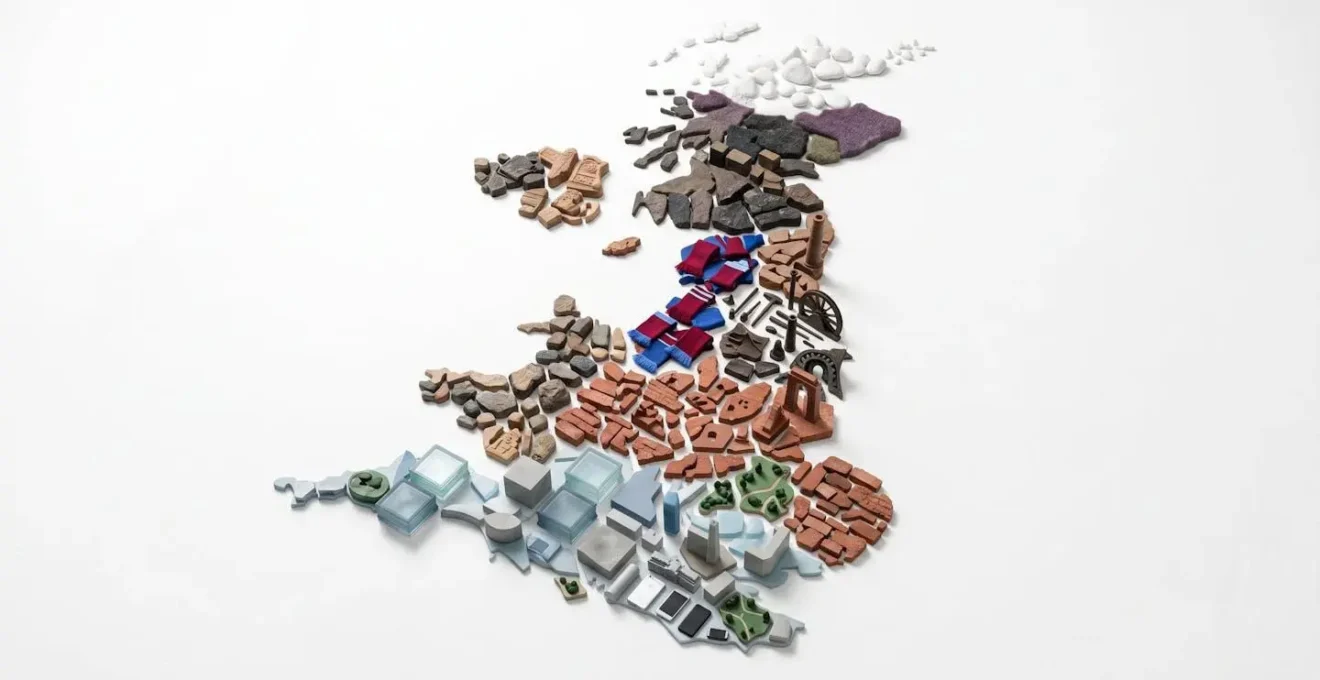
As the visual representation above suggests, the country is a blend of different identities, from the modern, globalised South East to the proud, industrial North. True strategic intelligence means using location not as a static data point, but as a proxy for cultural context. This could mean promoting different product lines, adjusting the tone of voice, or highlighting different brand values. For a fashion retailer, it might mean showcasing durable outerwear in the North while focusing on high-fashion items in the capital. For a food delivery service, it could be about promoting hearty, value-driven family meals in one region and quick, single-person office lunches in another.
Luxury Buyer or Bargain Hunter: How to Segment by Price Sensitivity?
Price sensitivity is one of the most powerful yet misunderstood aspects of segmentation. Lumping all customers into a « wants a discount » bucket is a catastrophic error. The UK consumer landscape is highly polarised: recent research reveals that 48% of UK consumers are more likely to buy when there’s a sale, while a separate 64% of loyal customers purchase without waiting for sales. This data reveals two distinct groups with opposing motivations. Sending a 50% off coupon to your most loyal, full-price buyers doesn’t build loyalty; it devalues your product and erodes your margin.
The goal is to differentiate between a « Bargain Hunter, » who is motivated purely by the lowest price, and a « Smart Value Seeker, » who is willing to pay more for quality, durability, and a good cost-per-use. Then there are « Luxury Buyers, » who may even be repelled by discounts, as it can dilute the exclusivity and perceived value of a brand. Each group needs a completely different conversation. The Bargain Hunter responds to urgent, aggressive discount messaging. The Smart Value Seeker needs content about craftsmanship and long-term benefits. The Luxury Buyer requires emails focused on exclusivity, new arrivals, and brand storytelling.
The following table provides a framework for identifying and communicating with these distinct price-sensitive segments. It’s a clear example of using data not just to group people, but to define a proactive marketing strategy for each.
| Segment Type | Behavior Indicators | Recommended Strategy |
|---|---|---|
| Luxury Buyers | High Average Order Value (AOV), ignores sale emails, buys new arrivals | Focus on exclusivity, quality, and ‘first look’ access |
| Smart Value Seekers | Researches before buying, reads reviews, moderate purchase frequency | Emphasise durability, cost-per-use, and positive reviews |
| Bargain Hunters | Only purchases during sales, high cart abandonment, responds to discount codes | Aggressive discount messaging, flash sales, and clearance alerts |
| Convenience Seekers | Values free/fast delivery over discounts, high repeat purchase rate | Highlight shipping benefits, easy returns, and subscription options |
The « Micro-Segment » Trap That Creates Too Much Work for Little ROI
In the pursuit of perfect segmentation, it’s easy to fall into a dangerous trap: over-segmentation. The idea of creating a unique email for every single customer persona seems like the ultimate goal, but in reality, it leads to diminishing returns, team burnout, and a messy, unmanageable campaign calendar. The effort required to create, manage, and analyse 50 micro-segments often outweighs the incremental lift in revenue you get from them. It’s a classic case of confusing activity with progress.
The key is to find the point of ‘good enough’ segmentation, where the return on investment (ROI) is highest. This is where the Pareto Principle (80/20 rule) applies: 80% of your results will likely come from 20% of your segmentation efforts. The goal is not to create a segment for « left-handed dog owners in Scotland who prefer blue, » but to focus on 3-5 core segments that represent significant differences in behaviour and profit potential.
As one expert notes when discussing the law of diminishing returns in a different context, the principle holds true for segmentation.
In very concrete terms: A bottle of wine that costs $30 will usually be much better than a $5 bottle. But between $30 and $50, the improvement, taste-wise, will be much less noticeable.
– Raphael Paulin-Daigle, The Essential and Complete Guide to Drip Marketing
The same logic applies here. The jump from one segment to five is massive. The jump from 20 to 25 is often negligible. A common pitfall for many businesses is creating too many persona-specific lists. A more sustainable approach is to build a few core segments aligned with primary business goals. For instance, a SaaS company might find maximum efficiency by focusing simply on ‘leads,’ ‘engaged trials,’ and ‘inactive users,’ rather than segmenting by 20 different industry verticals.
How Often Should You Refresh Your Segments to Keep Them Accurate?
Creating powerful segments is only half the battle. The other half is keeping them accurate. Customer behaviour is not static; it’s fluid. The « new subscriber » from last week is the « loyal customer » of next month, and the « VIP » who hasn’t purchased in 90 days is now an « at-risk » customer. Failing to account for this movement is how segments lose their power, a phenomenon known as segmentation decay. Using a three-month-old static list is like using an expired map.
The refresh cadence depends entirely on the nature of the segment. Static, demographic-based segments (e.g., ‘customers in Manchester’) rarely need updating. However, behaviour-based segments require constant attention. Modern email platforms offer dynamic segmentation, which automatically updates segments in real-time based on customer actions. For example, a user who clicks on a ‘sale’ link can be instantly moved into the ‘Bargain Hunter’ segment for their next email.

As the visual metaphor of the hourglasses suggests, different segments decay at different rates and thus require different refresh cadences. A one-size-fits-all approach is inefficient. A strategic framework for refresh frequency might look like this:
- New Subscriber Segments: Refresh daily or weekly. You are in a critical learning phase, and their first actions are highly predictive of their future value.
- VIP/Loyal Customer Segments: A monthly review is often sufficient. This is a more stable group, but you need to monitor for signs of lapsing.
- At-Risk Segments: These require real-time, trigger-based updates. The moment a customer meets an « at-risk » criterion (e.g., 90 days since last purchase), an automated re-engagement campaign should fire.
- Seasonal Segments: Increase refresh frequency in the run-up to key UK retail moments like Black Friday, Christmas, and Bank Holidays, as customer intent shifts rapidly.
Why Recency, Frequency, and Monetary (RFM) Analysis Beats Demographics?
Demographic data tells you who your customers *are*. RFM analysis tells you how they *behave* as customers—and that’s infinitely more valuable for predicting future purchases. It’s a classic method of strategic intelligence that remains one of the most powerful tools for e-commerce. RFM scores customers on three simple, action-based metrics:
- Recency: How recently did they purchase? (The most powerful predictor of future purchase).
- Frequency: How often do they purchase? (An indicator of loyalty).
- Monetary: How much do they spend? (Identifies your big spenders).
By combining these three scores, you can move beyond vague labels like « men aged 25-34 » and create highly predictive segments like « Champions » (bought recently, buy often, spend a lot) or « At-Risk » (used to be frequent buyers, but haven’t purchased in a while). You instantly know who to reward, who to nurture, and who to try and win back. This isn’t guesswork; it’s data-driven strategy. The impact on the bottom line is significant, with research showing campaigns using RFM segmentation can achieve up to a 77% boost in ROI.
Demographics can be misleading. A 22-year-old student and a 65-year-old retiree might both be in your « At-Risk » RFM segment, requiring a similar re-engagement strategy, despite their vastly different demographic profiles. RFM cuts through the noise to focus on what matters: their value as a customer.
Case Study: Growth Cave’s RFM Success
The marketing agency Growth Cave demonstrated the power of focusing on monetary value. Instead of using a standard lookalike audience for their client, they built one based exclusively on high-value customers identified through RFM analysis. By specifically targeting prospects who resembled customers with a high Average Order Value, they isolated the profit potential within their audience. This simple switch from a broad to an RFM-informed strategy increased their client’s ROI by a staggering 44%.
CDP vs CRM: Why Your Salesforce Instance Is Not Enough for Data Unification?
Many businesses believe their Customer Relationship Management (CRM) system, like Salesforce, is the single source of truth for customer data. It’s not. A CRM is excellent at managing linear sales processes and known customer interactions—sales calls, support tickets, and email history. However, it’s fundamentally not designed for the messy, non-linear, omnichannel world of modern marketing. It struggles to capture anonymous website behaviour, connect in-store purchases to online profiles, or unify data from mobile apps and social media.
This is where a Customer Data Platform (CDP) becomes essential. A CDP is built from the ground up for data unification. Its sole purpose is to ingest data from every single touchpoint—from anonymous first-time website visitors to loyal in-store shoppers—and stitch it all together into a single, persistent, and unified customer profile. In the complex UK B2B market, for example, where an average of 7 people are involved in purchasing decisions, a CRM might only track the primary contact. A CDP can unify the touchpoints from all 7 stakeholders, providing a complete picture of the buying committee’s journey.
The key differences are fundamental:
- Anonymous vs. Known: CRMs are primarily for known customers. CDPs excel at tracking anonymous users and unifying their profile once they identify themselves.
- Data Structure: CRMs use structured data related to sales interactions. CDPs are built to handle unstructured data from a vast array of sources (clicks, social, IoT, etc.).
- Real-Time Sync: CDPs are designed for real-time data synchronisation across all marketing channels, allowing for in-the-moment personalisation that CRMs can’t manage.
- Compliance: A modern CDP is built with GDPR compliance at its core, making it easier to manage consent and data privacy across all unified data sources.
In short, a CRM manages your relationship with the customer. A CDP manages and unifies the data about that customer, which then feeds the CRM and all other marketing tools with a much richer, more accurate picture. Thinking your CRM can do a CDP’s job is like thinking a family car can win a Formula 1 race. They are both vehicles, but designed for vastly different purposes.
Key Takeaways
- Behavioural data (clicks, RFM) is a far better predictor of future revenue than static demographics.
- Avoid the ‘micro-segment trap’; focus on 3-5 high-impact segments that align with business goals instead of creating endless lists.
- A Customer Data Platform (CDP) is non-negotiable for a true omnichannel strategy in the UK, unifying data that CRMs inherently silo.
Why a CDP Is the Missing Link in Your UK Omnichannel Strategy?
An omnichannel strategy is the holy grail for UK retailers, but for most, it remains a disconnected dream. The reality is often a multi-channel mess: the e-commerce team doesn’t know what the in-store team is doing, and the email marketing platform has no idea what a customer just did on the mobile app. This fragmentation shatters the customer experience. A Customer Data Platform (CDP) is the missing link that bridges these gaps, acting as the central nervous system for your entire omnichannel ecosystem.
The complexity of the modern customer journey necessitates this. Consider the findings from Dreamdata research, which reveals the average B2B journey involves 76 different touchpoints across 3.7 channels. Without a CDP, trying to track that journey is impossible. It’s the CDP’s ability to perform this data unification that unlocks a true omnichannel experience. For example, it connects the dots between a customer who sees a Facebook ad, clicks through to the website, abandons their cart, receives an email, and then finally uses a Click & Collect service at their local UK store.
A powerful UK-specific case is the integration of online and offline retail. A Klaviyo implementation for UK retailers demonstrated this perfectly. By using a platform with CDP capabilities to connect online behaviour with offline purchase data, they could launch powerful cross-selling flows. A customer buying a dress online could be sent an email with matching shoes available at their nearest store. This integration of data led to incredible results, with some campaigns achieving 60% open rates and 7% click-through rates, alongside a significant increase in average cart value. This isn’t possible when your online and offline data live in separate, walled-off gardens. The CDP is the key that unlocks the gate between them, finally delivering on the promise of a seamless, intelligent customer experience.
To move beyond « spray and pray, » the next logical step is to conduct a strategic audit of your current segmentation practices and data capabilities, identifying the gaps that a more intelligent, behaviour-driven approach can fill.